Foraging
Horse Chestnut vs Sweet Chestnut vs Buckeye: A Forager's Comparison
Every October the same scene plays out along the hedgerows: someone crouches over a glossy brown nut, turns it in a palm, and tries to work out whether it belongs in a roasting tin or on a piece of string. Horse chestnut, sweet chestnut, buckeye. Three names, three trees, and only one of them is dinner. Get it wrong and the best outcome is a mouthful of bitterness. So it pays to slow down and check the tree, not just the nut on the ground.
Quick comparison: what you are holding
The husk is the fastest tell, and it is the part most people never look at. Sweet chestnut husks are the hedgehogs: dense, fine, needle-sharp spines that jab through a thin glove. Horse chestnut husks are thick and leathery, with sparse, short, blunt spines or warty lumps. Buckeye husks are smooth or faintly lumpy, with no spines at all, and they usually split neatly into two or three valves.
- Sweet chestnut (Castanea species): spiny husk, usually two or three nuts inside. Nuts have a pointed tip and a flat, matte, pale base. Edible.
- Horse chestnut (Aesculus hippocastanum): leathery husk with blunt spines or warty bumps, usually one big nut inside. Glossy mahogany nut with a round pale scar. Not edible.
- Buckeye (Aesculus species): smooth or slightly warty husk, no spines. Shiny tan nut with a large pale "eye" covering much of one side. Not edible.
Horse chestnut: the classic conker
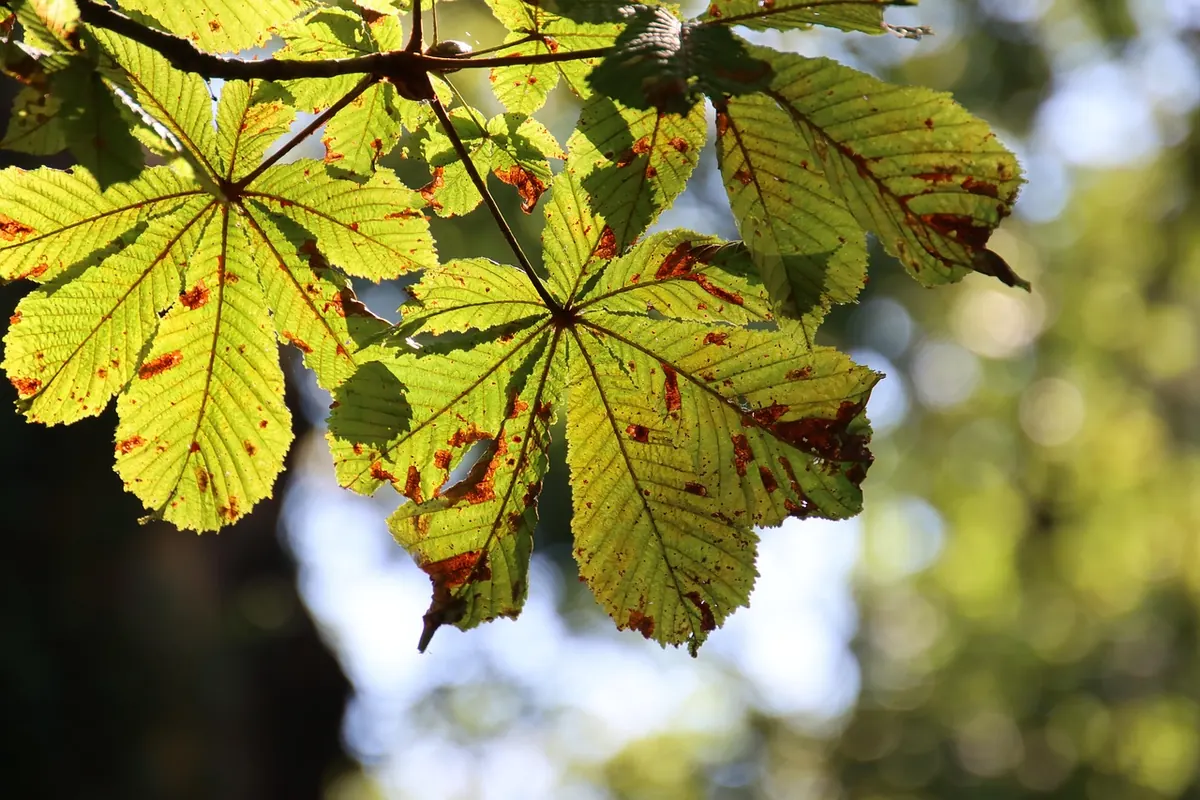
This is the tree most people mean when they say conker, and in Britain it is almost certainly the one in your pocket. The leaves are palmate: five to seven leaflets spreading from a single stalk like fingers from a hand, each leaflet widest beyond its middle with a coarsely toothed edge. In late winter the buds are sticky to the touch, which is a reliable way to name the tree when there is nothing else to see. In May it carries upright white flower spikes, sometimes called candles.
The nuts fall from September. They are round, heavy for their size, and deep mahogany, with a small round pale scar where they met the husk. They feel almost polished. Crush one and the kernel is pale and solid, but that is where the resemblance to food ends. Horse chestnuts contain aesculin and related compounds that are toxic to people and to most animals, and cooking does not fix that. Roasting a conker does not turn it into a chestnut; it just wastes a good conker.
The name itself is a warning. The "horse" prefix in old plant names generally meant coarse, tough or useless as food, and the tree has never been a serious food crop anywhere. It has other uses: a conker is a conker, and the saponins in the nuts lather in water, which is why they were once used for cleaning.
Sweet chestnut: the one you can actually eat
Sweet chestnut is a different genus entirely, and once you have seen it in leaf you will never mix the two up again. The leaves are long, narrow and lance-shaped, glossy dark green above, with a sharply serrated, bristle-tipped edge. They turn gold in late October. On older trees the bark is the giveaway: deep spiralling fissures that twist around the trunk like a rope.
The husk looks like a green sea urchin and demands gloves. Inside are two or three nuts, each flat on one side and rounded on the other, with a pointed tip and often a small pale tassel left from the flower. The base carries a large, dull, slightly fuzzy patch. Harvest from late September, and be quick about it: chestnuts are high in starch and low in fat, so they dry out and go mouldy faster than almost any other wild nut.
Eating them is straightforward. Raw, the flesh is crisp, starchy and a little astringent; roasted or boiled, it turns mealy and sweet. Score the shell before roasting so it does not burst, and peel away the bitter inner skin, which is much easier if you boil them for a few minutes first. Discard any nut that is soft, mouldy or has a neat round hole in it, which means the larvae of the chestnut weevil got there first.
Native relatives worth knowing
The American chestnut and the smaller Allegheny chinkapin produce nuts that are sweet and good to eat, in husks that are just as spiny as the European species. If you find a small, shrubby chestnut relative with spiny husks, you are still in edible territory. If the husk is smooth, you are not.
Buckeye: the American lookalike
Buckeyes are in the same genus as the horse chestnut, so the toxicity story is the same. Ohio buckeye and California buckeye are the ones most people meet, both planted widely in parks and gardens well outside their native range, which is exactly how they end up under trees where people hunt for sweet chestnuts.
The leaves are palmate with five leaflets, and many foragers find that crushed buckeye leaves have a rank, unpleasant smell. The husk is the important part: smooth and leathery, sometimes with a few warty bumps, but nothing you would describe as a spine. Inside sits a shiny nut, pale tan to chocolate brown, dominated by a large pale patch. That patch is the eye, and it is usually far bigger than the small round scar on a horse chestnut.
Spines that sting: chestnut. Blunt bumps and leather: conker. Smooth with a big eye: buckeye. Leave it.
Field checks that settle it in ten seconds
- Squeeze the husk. If it hurts, it is a chestnut. If it feels like thick leather with lumps, it is a horse chestnut or buckeye.
- Look at the base of the nut. A flat, matte, pale patch on a pointed nut means sweet chestnut. A small round scar on a round, polished nut means horse chestnut. A big pale eye means buckeye.
- Look up. Long, narrow, serrated leaves mean chestnut. Five to seven leaflets radiating from one stalk mean horse chestnut or buckeye.
- Look at the whole tree. Spiralling fissured bark and upright catkins in summer mean sweet chestnut. Sticky winter buds and white flower candles mean horse chestnut.
- If anything does not add up, put it down. A nut on the ground with no tree above it proves nothing.
Edibility and safety, plainly
Only sweet chestnuts are food. Horse chestnuts and buckeyes are not made safe by roasting, boiling, drying or peeling, and the compounds responsible are not destroyed by heat. Eating them can cause vomiting, stomach pain and worse, and symptoms may not appear immediately.
If a child or an adult has swallowed conkers or buckeye nuts, contact a poison information service or a doctor promptly rather than waiting to see what happens. If you are foraging for the first time, go with someone who already knows the trees, and never eat something identified only from a photograph or an app. Sweet chestnuts are genuinely edible, but they are a choking risk for small children, so cut them up.
One more thing: foraging has rules. Get the landowner's permission, check whether local bylaws allow collecting in parks and nature reserves, and take only what you will actually use.
The forager's autumn routine
Learn the tree in June, not in October. Visit when the leaves are fresh and the flowers are out, and you will recognise the tree later even when the husks are trodden into mud. Carry gloves, because sweet chestnut husks hurt more than you expect, and use a cloth bag rather than plastic, which holds moisture and turns a good haul mouldy overnight.
At home, spread your chestnuts in a single layer somewhere cool and airy and deal with them within a day or two. Score, roast or boil, peel while warm, and freeze what you cannot eat, because they will not keep. Leave plenty behind for the squirrels, the jays and next year's crop, and enjoy the conkers for what they are: a fine game, a lousy lunch.
Photo: DominikRh / Pixabay