Foraging
How to Identify Horse Chestnut Trees and Their Conkers
Every autumn, pockets across the country fill up with glossy brown spheres, and every autumn somebody carries home a bag of nuts they are convinced are sweet chestnuts. Horse chestnut trees are among the friendliest big trees to learn, because they advertise themselves loudly in every season. Get to know the leaves, bark, flowers, husks and seeds, and the confusion disappears.
Start With the Whole Tree
Horse chestnut, Aesculus hippocastanum, is a large, broad tree, often 20 metres or more, with a heavy, domed crown that spreads almost as wide as the tree is tall. The trunk is thick and the lower branches tend to sweep outwards and downwards, which gives old specimens a slightly hunched, generous shape.
It was brought to Britain from the Balkans a few centuries ago and planted almost entirely by people, so it turns up where people are: park avenues, village greens, churchyards, school playing fields, hospital grounds, street verges and the edges of country estates. Finding one deep inside a native oak or beech wood is unusual. That setting alone is a useful first clue.
Watch, too, for the red horse chestnut, a hybrid planted just as often. Its flowers are pink to deep red rather than white, and its husks tend to be less spiny.
Leaves: Five Fingers, Not a Feather
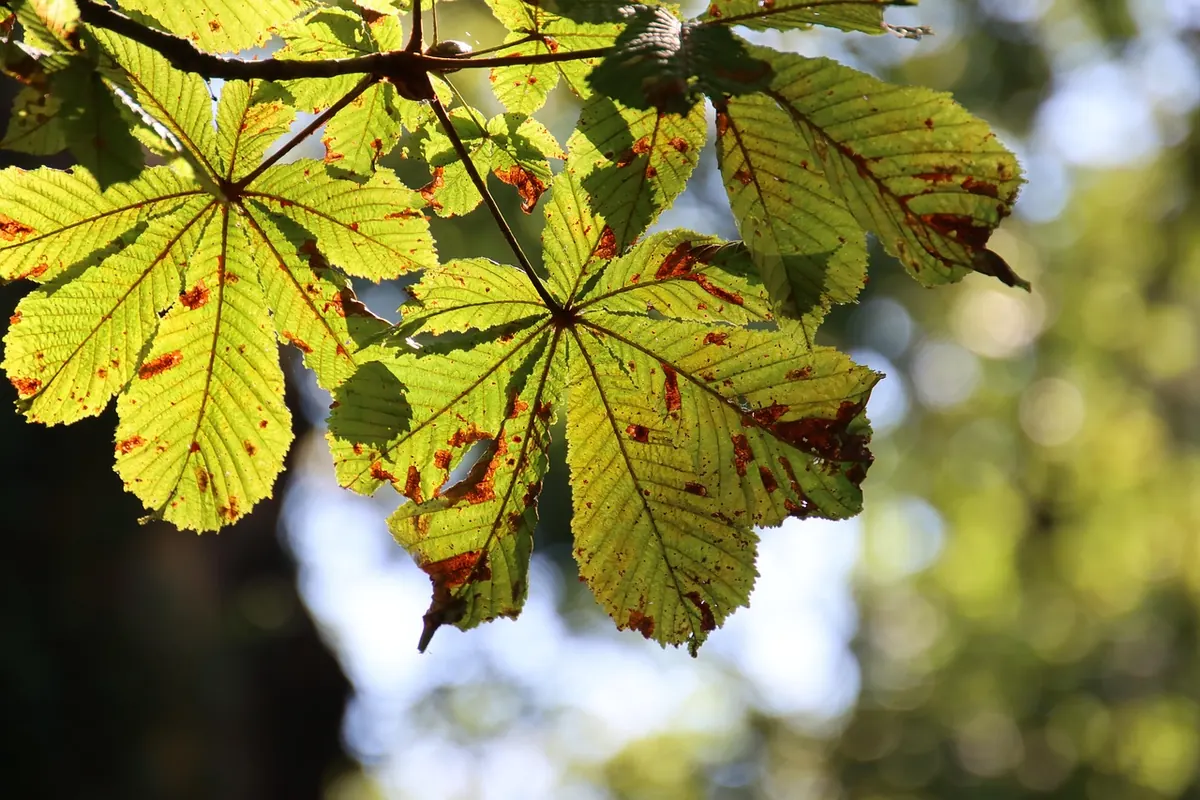
This is the fastest check you have. A horse chestnut leaf is palmate, meaning the leaflets spread from a single point at the end of the stalk like the fingers of a hand.
- Usually five leaflets, sometimes seven, each one 10–25 cm long.
- Each leaflet is widest beyond the middle, with a pointed tip and a finely double-toothed edge.
- The leaflets have no stalks of their own — they sit directly on the shared stem.
- The veins are deep-set, giving the leaf a corrugated, slightly leathery feel.
Sweet chestnut looks nothing like this once you compare them side by side. Its leaves are simple, not divided: one long, narrow, sharply serrated blade with a clear stalk, arranged alternately along the twig, with straight parallel veins running out to the teeth. If you are holding a single leaf that looks like a small, elegant paddle, you are looking at sweet chestnut, not horse chestnut.
In late summer, horse chestnut leaves often develop brown blotches and curl early, the work of the leaf-mining moth. Dry, patchy foliage in August is not proof on its own, but it is a supporting clue.
Bark, Twigs and Winter Buds
Young horse chestnut bark is smooth and grey-brown, sometimes with a faint greenish tinge. Older trunks break into scaly plates that flake and lift, often with shallow cracks between them. It is rarely deeply fissured the way an old oak is, and the overall impression is of grey, patchy armour rather than ridged bark.
In winter the twigs give the game away. They are stout and end in a large, shiny, sticky bud, reddish-brown and resinous to the touch, often 2–3 cm long. Few British trees have anything comparable.
Look below the buds and you will find big, horseshoe-shaped leaf scars, each dotted with small bundle scars like nail holes. Old stories link this horseshoe mark to the tree's name — it is one of the more satisfying identifications in a winter hedge.
Flowers, Husks and Spines
In May, horse chestnuts stand out from a distance: upright, cone-shaped clusters of white flowers that look like candles on a Christmas tree, each bloom marked with a yellow blotch that turns pink or red as it ages. Sweet chestnut flowers appear later, in July, as long, creamy, drooping catkins with a faint musty smell — showy in a quiet way, but nothing like a candle.
By September the husks are forming. A horse chestnut's casing is thick and leathery, roughly round, and covered in short, sparse, stubby spines. It usually splits into two or three valves and holds one to three conkers, sometimes more.
The sweet chestnut burr is a different creature: smaller, densely packed with fine, needle-sharp spines that will happily draw blood, holding two or three flat, pointed nuts. If you can pick the husk up without gloves, it is almost certainly horse chestnut.
Conker, Sweet Chestnut or Buckeye?
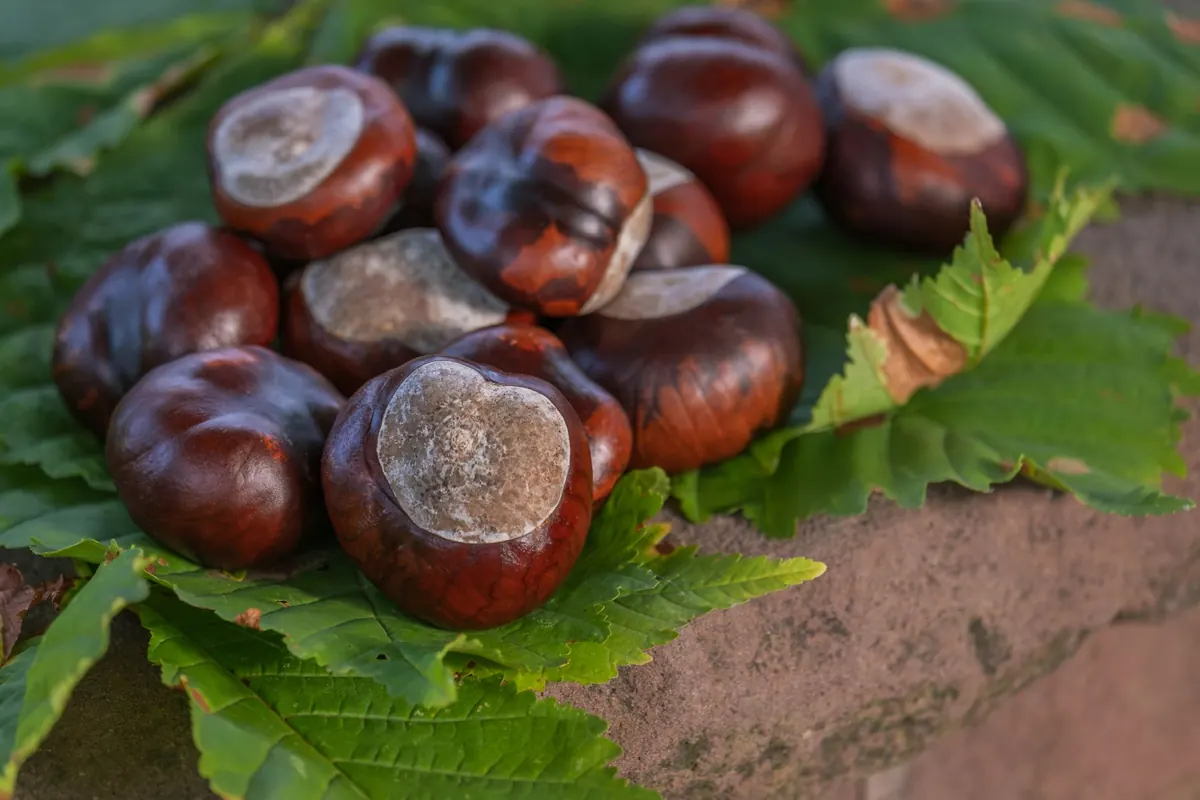
A ripe conker is round, 3–5 cm across, and glossy mahogany brown, with a large pale circular scar where it was attached inside the husk. That bullseye mark is your best single identifier. Where two seeds grew pressed together, one side will be flattened.
A sweet chestnut is much smaller, with one domed side and one flat side, a distinct pointed tip, a small papery tuft at the base, and a duller brown coat with faint lighter streaks. It is food. The conker is not — see the notes below.
Buckeyes, close relatives of the horse chestnut in the same genus, are the trickiest lookalikes. Their leaves are also palmate, and their husks can be spiny too, but the seeds are generally smaller, darker and more oval, with a paler scar that is not so bold. Scratch one and the smell is distinctly unpleasant. The Ohio buckeye is named for it. Unless you are in a botanic garden or an arboretum, you are unlikely to meet one in Britain, but it is worth knowing the shape of the problem.
A quick field checklist, in order:
- Five big leaflets on one stem, no individual leaf stalks: horse chestnut.
- Single long serrated leaf with a stalk: sweet chestnut.
- Upright white flower candles in May: horse chestnut.
- Spiky husk with few short spines, round glossy seed with a big pale scar: conker.
- Densely needle-spined burr, flat pointed nut with a tuft: sweet chestnut.
Collecting Conkers: Practical Rules
Gather from the ground. Conkers that are still in the tree are not ripe, and you will be doing damage by shaking or breaking branches. Early windfalls are often pale and soft; the best ones drop as the husks split in late September and October, and they feel solid and heavy for their size.
Only take where you have permission. In public parks, local rules and bylaws vary, and anything growing on private land is out of bounds without the owner's say-so. Take a handful rather than a sackful, spread your collecting across several trees, and leave plenty behind — deer, squirrels and other animals eat them.
A few safety points worth knowing. Horse chestnut seeds contain aescin and related compounds and are not edible: bitter, and toxic if eaten in quantity. Do not roast, grind or brew them, and do not feed them to pets, horses or livestock. Wash your hands after handling a large haul, and if a child or animal does swallow one, contact a doctor, vet or poison service promptly. If you are storing conkers for play, dry them for a few days out of direct sun, then drill through the centre with a suitable bit and a vice, thread them onto a lace, and knot the end firmly.
None of this is difficult once you have looked at one tree properly. Find a horse chestnut in May, look again in September, and the difference between conker, sweet chestnut and buckeye will stay with you for good.
Photo: Ilo Frey / Pexels